- MAIN PAGE
- – elvtr magazine – How AI is Reshaping Physical and Industrial Product Design
How AI is Reshaping Physical and Industrial Product Design
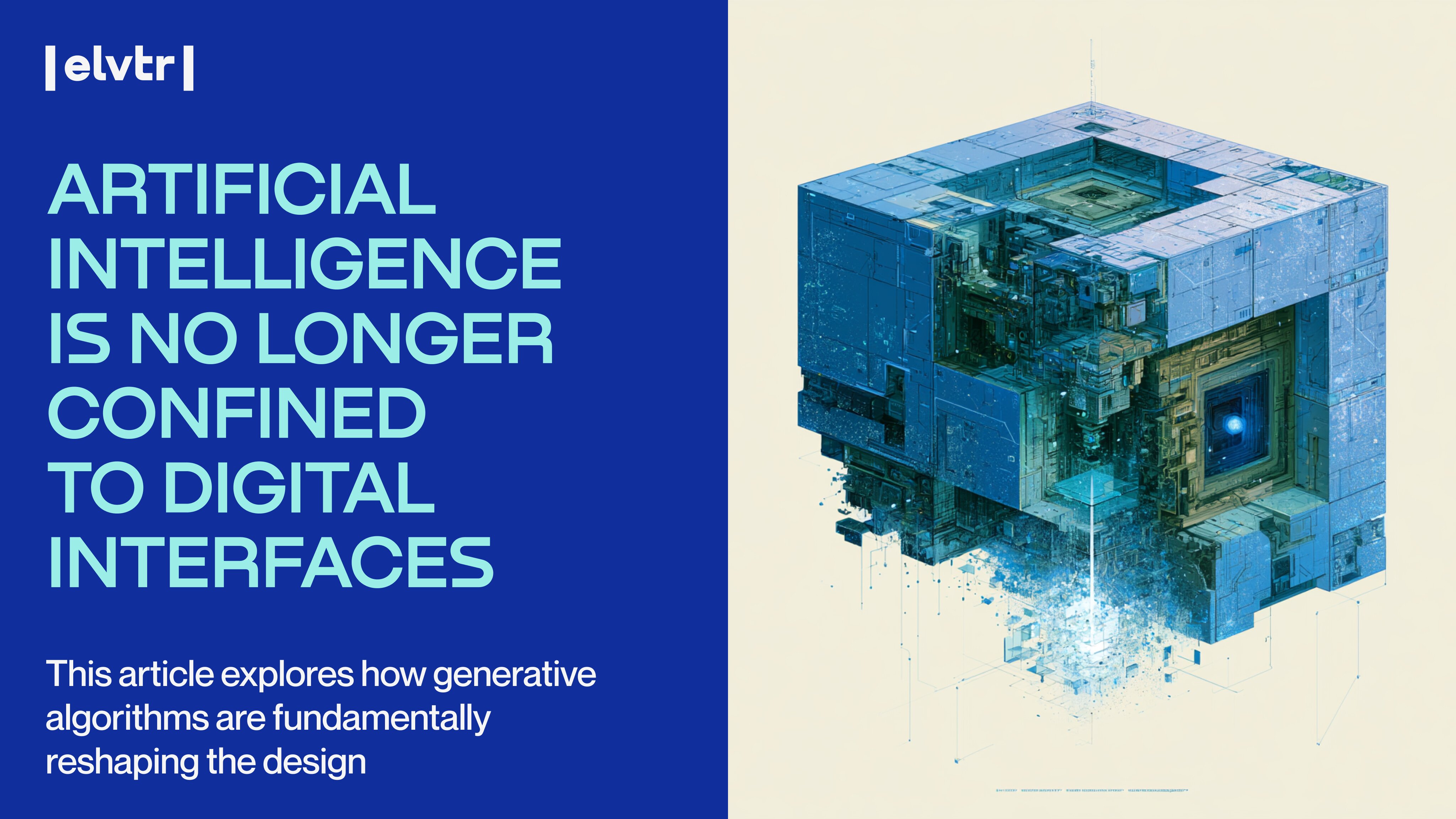
This article explores how generative algorithms are fundamentally reshaping the design of physical products, from optimising hardware ergonomics and material efficiency to creating complex structures for advanced manufacturing. Industrial designers are now using AI as a creative partner to build a smarter, more sustainable, and human-centered tangible world.
The New Industrial Revolution is Algorithmic
For decades, the product designer’s toolkit has been an evolution of the familiar: sketching, modelling clay, CAD software. These tools improved precision and speed, but the creative process remained fundamentally human-driven. The designer conceived an idea, refined it through iteration, and translated it into a manufacturable object. The new revolution is not about better drawing tools; it's about a new creative partner — the algorithm.
Artificial intelligence, specifically in the form of generative design, has moved from a theoretical concept to a practical, powerful force in industrial design studios. Designers are moving from drawing a specific solution, to defining the problem. They input a set of goals and constraints: this part must support a certain load, weigh no more than X kilograms, be made from titanium, fit within this specific spatial envelope, and be manufacturable via 5-axis milling.
Think of the AI as your tireless, hyper-creative sidekick. It doesn't just refine one idea; it explores the entire solution space, generating hundreds, sometimes thousands, of design permutations that satisfy the given criteria. The results are often alien, organic, and counter-intuitive. They are forms that a human designer, constrained by established aesthetics and cognitive biases, would likely never conceive. These designs are mathematically optimised for performance; every curve, every strut, every hollow space exists for a reason — to maximise strength, minimise weight, or improve thermal dynamics. This is a new way of thinking about form and function.
Generative Design: Beyond Human Intuition
The most visible application of AI in physical product design is generative design, a subset of AI that autonomously creates optimal designs from a set of system requirements. It represents a fundamental departure from the iterative, human-led refinement process that has defined design for centuries.
Consider the classic engineering challenge of lightweighting — reducing a component's mass while maintaining or increasing its structural integrity. This is critical in industries like aerospace and automotive, where every gram saved translates to fuel efficiency and performance gains. A human engineer might shave material from areas they intuit are under less stress, run a simulation, and repeat. This process is slow, laborious, and limited by the engineer's experience and imagination.
Generative design automates and accelerates this process exponentially. The designer becomes a problem-framer. They input the boundary conditions: connection points, keep-out zones where other components must fit, applied loads, and material choices. They also define the objective function — for example, "minimise mass while keeping stress below a critical threshold."
The AI-powered software then begins its work. Using algorithms inspired by natural evolutionary processes, like bone growth, it "grows" a design. It starts with a block of material and iteratively removes what isn't needed, reinforcing pathways where stress is highest. The output is a collection of optimised topologies, often resembling skeletal structures or biological forms. These are not simply aesthetic choices, but the most efficient possible distributions of material to solve the specific engineering problem.
A landmark example is the collaboration between Autodesk and Airbus on the "bionic partition" for the A320 aircraft. This partition separates the passenger cabin from the galley and must be incredibly strong to withstand the force of a 16g crash test while supporting jump seats for the cabin crew. The original design was a solid, heavy panel. Using generative design, engineers defined the connection points and load requirements. The resulting AI-generated design was a complex, web-like structure that looked more like something from a sci-fi film than an airplane. It met all strength requirements but was 45% lighter than its predecessor. This single component saves thousands of gallons of jet fuel per aircraft per year. This outcome would have been virtually impossible to achieve through traditional design methods. It highlights how AI can uncover radically efficient solutions that lie beyond the scope of human intuition.
Materials Science and Manufacturing Reimagined
The intelligence of these systems extends beyond mere geometry. Modern AI tools integrate deep knowledge of material science and manufacturing processes, ensuring that the generated designs are not just theoretically optimal but also practically achievable.
An algorithm can be instructed to design a part specifically for additive manufacturing (3D printing). This unlocks the potential for incredibly complex internal geometries, such as lattice structures, which provide immense strength with minimal material usage. These structures are impossible to create with traditional subtractive methods like milling or casting. The AI understands the constraints and opportunities of 3D printing — such as support structure requirements and print orientation — and incorporates them directly into the design process. This is the core of Design for Additive Manufacturing (DfAM), where the manufacturing method itself informs the object's fundamental design. Industrial designers can now leverage algorithmic AI to generate structurally complex product casings that are perfectly optimised for 3D printing, creating hardware that is lighter, stronger, and more thermally efficient than ever before.
Furthermore, AI is accelerating the discovery and application of new materials. Machine learning models can analyse vast datasets of material properties to predict the performance of novel alloys or composites before they are ever synthesised. This allows designers to explore a much wider palette of materials, finding the perfect combination of strength, weight, flexibility, and thermal resistance for a given application. For instance, an AI could be tasked with finding the optimal composite layup for a bicycle frame, balancing stiffness for power transfer with compliance for rider comfort, all while minimising weight.
This data-driven approach also has profound implications for sustainability. Designers can set "minimising carbon footprint" or "maximising recyclability" as key objectives. The AI can then calculate material efficiency, suggesting designs that reduce waste during manufacturing (e.g., by fitting perfectly onto a standard sheet of metal) or prioritising the use of recycled or biodegradable materials. It can simulate the entire product lifecycle, from raw material extraction to end-of-life disposal, providing a holistic view of a design's environmental impact and guiding designers toward more responsible choices.
Designing for Humans: The Ergonomic Frontier
While structural optimisation and material efficiency are powerful, the ultimate measure of many products is how well they interface with a human being. This is the domain of ergonomics, and here too, AI is providing unprecedented levels of insight and customisation.
Traditional ergonomic design relies on anthropometric data — tables of average human measurements — and user testing with small sample groups. This often leads to a "one-size-fits-most" approach, which inevitably fails to accommodate the full diversity of the human body. AI offers a path toward truly personalised and adaptive design.
By feeding AI models with vast datasets from 3D body scans, motion capture studies, and pressure sensor readings, designers can simulate how thousands of different virtual users would interact with a product. Instead of designing a single car seat, an automotive company can use AI to generate a core seat structure that can be mass-customised for individual drivers, optimising support and comfort based on their specific height, weight, and posture.
This is particularly transformative in the design of tools and medical devices. Power tool manufacturers can analyse motion capture data of workers to design grips that minimise repetitive strain injuries. An AI can analyse the forces exerted on a surgeon's hand and generate a scalpel handle that maximises control and reduces fatigue during long procedures. In prosthetics and orthotics, generative design is used to create custom-fit implants and braces that perfectly match a patient's anatomy, derived from MRI or CT scans. These devices are not just more comfortable; they are more effective because their form is a direct, data-driven response to the user's unique biological needs.
The result is a shift from designing for the "average" human to designing for the individual. AI allows industrial designers to leverage algorithmic intelligence to optimise hardware ergonomics at a granular level, creating products that are not just functional but feel like a natural extension of the user's body.


The Evolving Role of the Designer
The rise of AI in design studios inevitably raises a critical question: what is the future role of the human designer? The fear of being replaced by a more efficient algorithm is palpable. However, the reality is more nuanced and, ultimately, more empowering. AI is not an autonomous creator; it is a powerful collaborator that augments, rather than replaces, human creativity.
Designers are moving away from the old-school days of sweating over every curve. Now, it’s all about strategy and curation. The most critical skills are no longer just proficiency in CAD software but the ability to frame a problem intelligently. The quality of a generative design output is entirely dependent on the quality of the input — the goals and constraints defined by the human. The designer must ask the right questions: What are the true objectives of this product? What are the non-negotiable constraints? What defines success? This requires a deep understanding of the user, the business context, and the engineering principles at play.
Once the AI generates a multitude of potential solutions, the designer's role becomes one of curation. The algorithm can identify designs that are mathematically optimal, but it lacks aesthetic judgment, cultural awareness, and an understanding of brand identity. It cannot tell a story. The designer must sift through the options, using their intuition and experience to select the solution that is not only high-performing but also beautiful, elegant, and emotionally resonant. They may choose a design that is 2% less efficient but 100% more desirable to the end-user.
In this new partnership, AI handles the heavy lifting of complex calculations and boundless iteration, freeing the designer to focus on higher-level strategic thinking. It automates the tedious and allows more time for the purely human aspects of design: empathy, storytelling, and creative vision. The designer is no longer just a creator of objects but a conductor of a complex system, orchestrating the interplay between user needs, business goals, and the immense computational power of the machine.
The Inevitable Challenges and Ethical Guardrails
As with any transformative technology, the integration of AI into product design is not without its challenges and ethical considerations. Navigating these issues is crucial for ensuring that this powerful tool is used responsibly.
One significant hurdle is the "black box" problem. Many advanced machine learning models, particularly deep neural networks, can arrive at a solution without their human operators being able to fully comprehend the reasoning behind it. An AI might generate a highly efficient but bizarrely shaped component, and engineers may struggle to verify why that specific geometry is optimal. This lack of transparency can be a barrier to adoption in safety-critical applications where every design decision must be justifiable and auditable.
Data bias is another serious concern. AI systems learn from the data they are trained on. If that data is skewed or incomplete, the resulting designs will perpetuate and even amplify those biases. For example, an AI trained on ergonomic data primarily from a specific demographic might consistently produce designs that are uncomfortable or unusable for people outside that group. This could lead to a new generation of products that inadvertently exclude significant portions of the population. Designers must be vigilant about curating diverse and representative datasets to train their AI models.
There is also the risk of aesthetic homogenisation and over-optimisation. If all designers begin using the same generative algorithms with similar inputs, we could see a convergence toward a singular, algorithmically-derived aesthetic — a world filled with hyper-efficient, lattice-filled, bionic-looking objects that lack character and soul. The human touch — the intentional imperfection, the cultural reference, the spark of unexpected creativity — remains essential. A design can be perfectly optimised for performance and still be a complete failure if it doesn't connect with people on an emotional level.
Finally, questions of intellectual property and ownership are becoming increasingly complex. If an AI generates a novel and valuable design, who owns the patent? The designer who defined the inputs? The company that owns the software? The engineers who wrote the algorithm? The legal and ethical frameworks surrounding creative AI are still in their infancy and will require careful development as these tools become more prevalent.
From sleek tech hardware to ergonomic consumer goods, learn how to build better physical products using algorithmic design. Join our AI Product Design course and discover how to fuse data-driven optimisation with beautiful aesthetics. Ready to get hands-on with the future? Start building.
A New Tangible Reality
The integration of artificial intelligence into physical and industrial product design is not a future-tense proposition; it is happening now. It marks a pivotal moment in the history of making things, comparable to the invention of the assembly line or the advent of CAD. AI is enabling the creation of objects that are lighter, stronger, more efficient, and more attuned to human needs than ever before.
This shift moves design from a process of intuition and iteration to one of exploration and optimisation at a massive scale. It provides a powerful new lens through which to solve complex engineering problems, pushing the boundaries of what is possible in materials, manufacturing, and form. The result will be a world filled with smarter, more sustainable, and more beautiful objects — products born from a unique synergy of human creativity and machine intelligence. The designer’s hand is no longer the sole author of the physical world, but the thoughtful guide for an incredibly powerful new partner.